Frequently Asked Questions
The most-asked questions about the viking age.
What exactly is the Viking Age?
It refers to roughly 800–1100 CE, a period when seafaring Norse peoples from Scandinavia launched raids, built trade networks, and settled across much of Europe, the Atlantic, and into the Mediterranean. It is not a single unified civilization but a broad era of cultural and political transformation.
Who were the Vikings, and where did they come from?
They were speakers of Old Norse hailing from modern-day Norway, Sweden, and Denmark, though the word 'viking' in Old Norse originally meant a raider or pirate. They were farmers, traders, and craftsmen as much as warriors, and their identity was more regional than national.
When did the Viking Age begin and end?
The conventional starting point is the raid on Lindisfarne in 793 CE, and the ending is usually placed around 1066 with the Battle of Hastings, though some scholars extend it into the early twelfth century. In practice the transition was gradual rather than a single dramatic event.
Which regions did Vikings actually reach?
Their seafaring carried them to Ireland, France, the British Isles, Iceland, Greenland, and North America (Vinland), as well as eastward along rivers into Russia, the Byzantine Empire, and the Arab world. They established permanent colonies in places like Dublin, York, and the Danelaw.
Who are the most famous Viking figures?
Leif Erikson is credited with reaching North America around 1000 CE, while Ragnar Lothbrok and his sons—though their historicity is heavily debated—dominate Norse saga literature. On the political side, Cnut the Great, who simultaneously ruled England, Denmark, and Norway, represents the era's peak of Norse power.
What gods and beliefs did the Vikings hold?
They practiced a polytheistic Norse religion centered on figures like Odin, Thor, and Freyja, with a worldview that emphasized fate and a cyclical cosmos. There was no central church or formal priesthood; religion was woven into daily life, law, and seasonal ritual.
How was Viking society structured?
There was no single 'Viking kingdom'; communities organized around local assemblies (things) where free men made collective decisions. Social rank ranged from thralls through free farmers to jarls and kings, and a man's reputation and oath-keeping mattered as much as his bloodline.
What made Viking ships so effective?
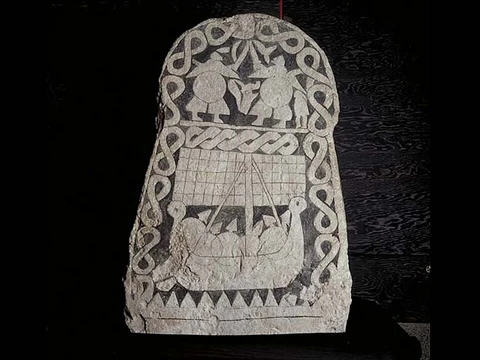
Their clinker-built longships combined a shallow draft for river travel with a deep hull for open-sea voyages and could be rowed or sailed depending on conditions. This versatility let the same vessel carry a raiding party up a river to a monastery or across the North Atlantic to Iceland.
How do historians reconstruct the Viking Age?
Sources include Icelandic sagas, the Anglo-Saxon Chronicle, Arabic travel accounts, and a growing body of archaeological evidence from sites like Birka, Hedeby, and L'Anse aux Meadows. Because written records were kept largely by outsiders such as monks and Arab geographers, modern scholarship leans heavily on material culture to fill the gaps.
What ended the Viking Age?
The Christianization of Scandinavia, the consolidation of centralized kingdoms, and a shift in trade routes all reduced the conditions that had fueled large-scale raiding. By the eleventh century, former Viking societies were largely integrated into the broader European feudal and ecclesiastical order.