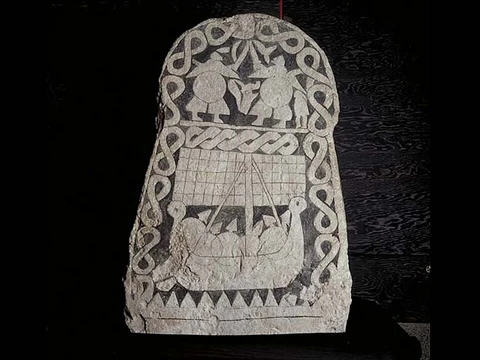
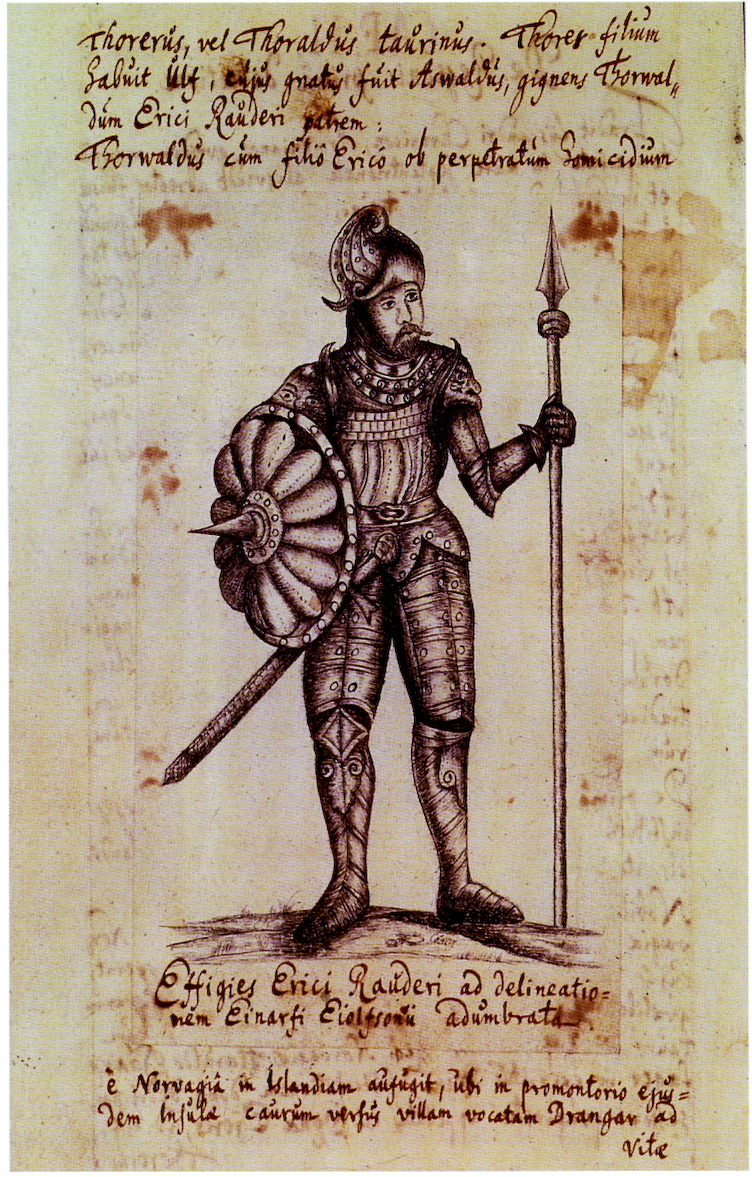
Erik the Red
Norse explorer who founded Greenland's first European settlement.

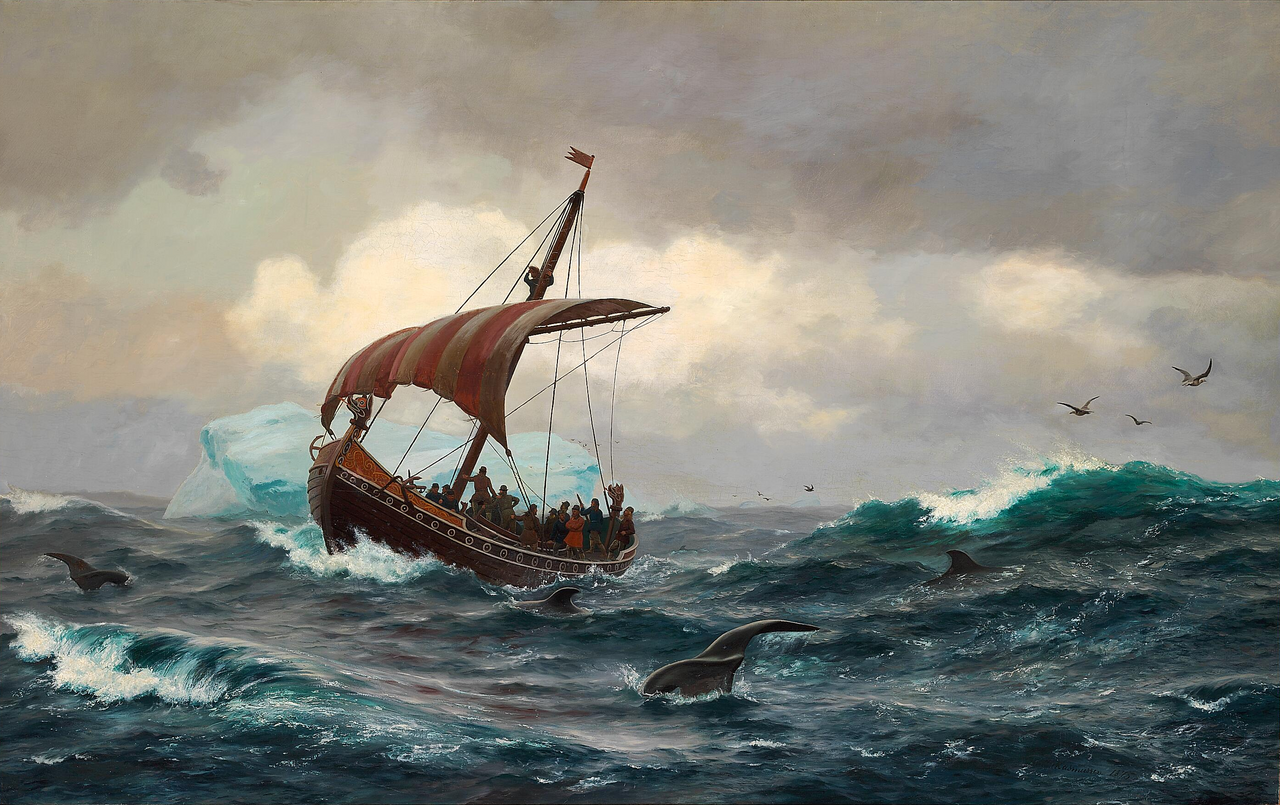
Carl Rasmussen · Public domain
Erik Thorvaldsson (c. 1003), known as Erik the Red, was a Norse explorer who, according to medieval Icelandic saga sources, founded the first European settlement in Greenland. He most likely earned the epithet 'the Red' due to the color of his hair and beard. His significance lies in his successful colonization of Greenland and as the father of Leif Erikson, the explorer of Vinland.
- died
- c. 1003 CE, Greenland
- field
- Exploration
- nationality
- Norse
- known_for
- Founding the first successful European settlement in Greenland
Lore & Background
Erik Thorvaldsson was born in the Jæren district of Rogaland, Norway, the son of Thorvald Asvaldsson. When Thorvald was banished from Norway for manslaughter, the family sailed west to Iceland, settling in Hornstrandir. After his father's death, Erik married Þjódhild Jorundsdottir and moved to Haukadalr, where he built a farm called Eiríksstaðir. They had at least three sons: Leif Erikson, Thorvald, and Thorstein; sources differ on whether a daughter, Freydís, was a full sister or half-sister to Leif. Unlike his wife and son Leif, who became Christians, Erik remained a follower of Norse paganism, and the sagas relate that his wife withheld intercourse from him due to his refusal to convert. During his exile, he explored Greenland, rounding the southern tip and sailing up the western coast, where he found ice-free areas promising for settlement. He spent his first winter on the island of Eiriksey, the second in Eiriksholmar, and explored northward in the final summer. Upon returning to Iceland, he named the land 'Greenland' to attract settlers, saying people would be drawn to a favorable name. In 985, he led a colonization fleet of 25 ships, of which only 14 arrived; the survivors established the Eastern and Western Settlements on the southwest coast. Erik built his estate Brattahlíð in the Eastern Settlement and became the paramount chieftain of Greenland, greatly respected and wealthy. His son Leif Erikson later explored Vinland, but Erik declined to join after falling off his horse, which he took as a bad omen.
Reader's Guide
Erik the Red's primary significance is as the founder of the first successful European settlement in Greenland, a feat that established a Norse colony lasting centuries. His exploration during exile and deliberate naming of Greenland to encourage immigration demonstrate his leadership and strategic thinking. The colony he founded grew to about 5,000 inhabitants and survived until the Little Ice Age made it marginal, with additional factors including pirate raids, conflict with Inuit, and abandonment by Norway. Erik's legacy is also tied to his son Leif Erikson, who became the first Norseman to explore Vinland (North America). The sagas preserve both Erik's achievements and the disputes surrounding his life, such as the differing accounts of his daughter Freydís. His story illustrates the Norse expansion across the North Atlantic and the interplay between exploration, conflict, and settlement in medieval Iceland and Greenland.
Did You Know?
- Erik most likely earned the epithet 'the Red' due to the color of his hair and beard.
- Erik named the land 'Greenland' to attract settlers, saying people would be drawn to a favorable name.
- He died around 1003 CE during a winter epidemic that killed many colonists.
A Life Shaped by Banishment
Erik Thorvaldsson's existence was defined by displacement from his earliest years. He married Þjódhild Jorundsdottir and built a farm called Eiríksstaðir in the Haukadalr valley. Yet the cycle of conflict and exile that had marked his father's fate repeated with grim familiarity. A dispute over a landslide caused by Erik's thralls on a neighbor's property escalated into bloodshed: Erik killed Eyjolf the Foul and Hrafn the Dueller in retaliation. A separate confrontation with Thorgest over inherited ornamented pillars of mystical significance ended with Erik slaying Thorgest's sons. The Thorsnes Thing ultimately outlawed him and his allies from Iceland for three years—a sentence that, by historical accident, set him on a course toward one of the great Norse discoveries.
Three Winters in the Unknown
He rounded the southern tip of what would later be called Cape Farewell and followed the western coastline northward until he found stretches of shore largely free of ice, with growing conditions reminiscent of Iceland itself. Over the next three years he explored methodically: the first winter he spent on the island he named Eiriksey, the second in Eiriksholmar near Hvarfsgnipa, and the final summer he pushed as far north as Snaefell and into Hrafnsfjord. When his exile expired and he returned to Iceland, he carried with him tales of a vast, habitable land he called Greenland. His achievement set him apart from predecessors such as Gunnbjörn Ulfsson, whose accidental sighting of distant skerries had gone largely unremembered, and Snæbjörn galti, whose earlier colonization attempt had collapsed under the brutality of a Greenland winter. Erik's settlement was the first to endure, establishing him as the recognized founder of Europe's first permanent community on the island.
A Household Divided by Faith
Erik's marriage to Þjódhild Jorundsdottir, daughter of Jorundur Ulfsson and Þorbjorg Gilsdottir, produced a family at the very center of Norse exploration. Their children included three sons—Leif, Thorvald, and Thorstein—and a daughter, Freydís, whose exact relationship to her brothers is disputed between the two surviving sagas. The household at Eiríksstaðir was a place of both ambition and deep personal tension. As Christianity spread through the Norse world, Þjódhild embraced the new faith wholeheartedly, even commissioning the first church in Greenland. Erik, by contrast, clung fiercely to the old Norse gods and openly despised the Christian religion. The sagas record that this theological rift became so acute that Þjódhild withheld her body from him in protest. Their son Leif, like his mother, became a Christian and went on to become the first Norseman to reach Vinland in what is presumably modern-day Newfoundland. Erik's own religious conservatism marked a generational divide within a family whose members would touch the far edges of the known world.
The Last Voyage and the Winter's End
In the final years of his life, Erik was offered a chance to join his son Leif on the extraordinary voyage to Vinland, the land beyond Greenland that Leif had discovered. According to the sagas, Erik accepted the invitation but, en route to the ship, he fell from his horse. He interpreted the fall as an ill omen and declined to board, leaving his son to sail without him. That decision proved fateful in a different way: Erik remained in Greenland and died around 1003 during a winter epidemic that swept through the colony and claimed many of its settlers. His death in that harsh season marked the end of a life defined by displacement, violence, and relentless exploration. The epithet the Red, which medieval and Icelandic saga sources attached to his name, most likely referred simply to the color of his hair and beard. Yet his legacy endured far beyond his physical appearance: as the founder of the first successful European settlement in Greenland, he opened a corridor of Norse presence in the North Atlantic that would, through his son's generation, extend all the way to the shores of North America.
Common Misconceptions (Editorial)
Some people assume that Erik the Red named Greenland because the land was actually green and fertile, but according to the record, he named it "Greenland" to attract settlers, saying people would be drawn to a favorable name. Others mistakenly believe Erik was a Christian like his son Leif Erikson, but the facts state that Erik remained a follower of Norse paganism and refused to convert. It is also commonly thought that Erik personally explored Vinland, but the record confirms that his son Leif explored Vinland, and Erik declined to join after falling off his horse, which he took as a bad omen.
Why It Matters (Editorial)
Erik the Red matters because he transformed a harsh, ice-covered island into a viable Norse colony, proving that exploration and settlement could succeed even in the most unforgiving environments. His story endures not only as a tale of pioneering ambition but as a bridge between the legendary sagas of Iceland and the real-world discovery of North America through his son Leif Erikson.
Gallery


Frequently Asked Questions
Why is he called 'the Red'?
The epithet almost certainly refers to the striking red color of his hair and beard, a physical trait the saga tradition uses to distinguish him from other Norse figures. It was not a title of rank or achievement but simply a descriptive nickname.
What did Erik the Red actually accomplish?
He organized and led a Norse expedition that established the first permanent European settlement on the coast of Greenland. That colony became the springboard for his son Leif's later voyage to Vinland.
How does Erik the Red's story end?
He died around 1003 CE in Greenland, the very land he had made his home after being exiled from Norway. The sagas record no dramatic final battle or adventure; his life simply closes in the territory he founded.
Why does Erik the Red matter in Viking Age history?
His successful Greenland colony demonstrated that Norse communities could survive and thrive in extreme northern conditions, proving the limits of their seafaring reach. He also stands as the direct father of Leif Erikson, making him the crucial link between Norway and the eventual Norse contact with North America.
More in The Viking Age 1-21
Spotted an error? Know more?
This is a living reference — every entry is fact-audited, and reader corrections feed straight into our audit queue. Suggest an edit · See this site's audit record