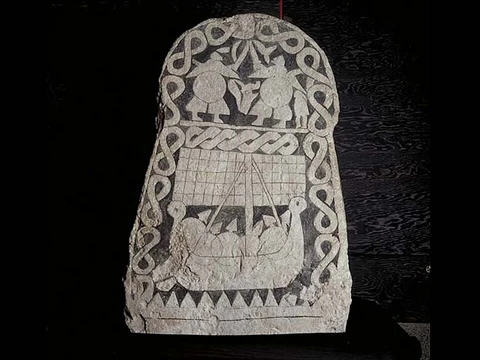
Ivar the Boneless
Viking leader who invaded England and Ireland.

Ivar the Boneless (Old Norse: Ívarr hinn Beinlausi; died c. According to the Tale of Ragnarr Loðbrók, he was the son of Aslaug and Ragnar Loðbrok, and brother of Björn Ironside, Halvdan (or Hvitserk), Sigurd Snake-in-the-Eye, and Ragnvald, though the historicity of this is uncertain.
- born
- Unknown
- field
- Viking leader, military commander
- nationality
- Norse (Viking)
- known_for
- Leading the Great Heathen Army's invasion of Anglo-Saxon England; possibly identical to Ímar, king of Dublin
Lore & Background
The invasion was organized by the sons of Ragnar Lothbrok to avenge Ragnar's execution by Ælla of Northumbria, though the historicity of this explanation is unknown. According to saga, Ivar initially sought reconciliation with Ælla, asking only for as much land as he could cover with an ox's hide, then cut the hide into fine strands to envelop a large fortress. In 867, the army captured Ælla at York, and legend holds that Ivar and his brothers executed him using the blood eagle, a ritual method of debated historicity.
Reader's Guide
Ivar the Boneless is significant as a key figure in the Viking invasions of Anglo-Saxon England, leading the Great Heathen Army that overthrew multiple kingdoms. His nickname 'boneless' remains mysterious: sagas claim he was born with a skeletal condition or was impotent, while another hypothesis suggests a scribal error from Latin 'exosus' (the hated). He is often identified with Ímar, founder of the Uí Ímair dynasty that ruled Northumbria and Dublin, making him an ancestor of the Crovan dynasty. A Scandinavian burial mound at Repton, Derbyshire, containing over 250 partial skeletons, has been suggested as his possible resting place. Saga accounts claim Ivar ordered his burial in an exposed place, prophesying that foes would be met with ill-success until William I of England broke the mound and burned his undecayed body.
Did You Know?
- The reason for Ivar's nickname 'boneless' is unclear; some sagas claim he was born with a skeletal condition that left him unable to walk, while others suggest he was merely impotent.
- According to the Tale of Ragnar Lodbrok, Ivar's bonelessness was the result of a curse because his father Ragnar did not wait three nights before consummating his marriage with Aslaug.
- A Scandinavian burial mound at Repton, Derbyshire, containing over 250 partial skeletons, has been suggested as possibly Ivar's last resting place.
Ivar's Place at the Helm of the Great Army
All three were sons of the semi-legendary figure Ragnar Lodbrok, and together they directed a coalition of Scandinavian warriors that represented a dramatic escalation in scale and ambition compared to the smaller raiding parties that had been hitting English shores since the late eighth century. Where earlier expeditions had targeted isolated monasteries and trading posts for quick plunder, this force was explicitly organized to conquer and hold territory across all four Anglo-Saxon kingdoms—East Anglia, Northumbria, Mercia, and Wessex. The Anglo-Saxon Chronicle, from which the army takes its name, described it as among the largest military forces of its era, though no surviving source gives a precise headcount. The campaign that Ivar helped direct stretched across fourteen years of continuous warfare, negotiation, and territorial expansion, making it one of the most sustained military operations of the early medieval period.
Fourteen Years of Marching and Conquest
The military record of Ivar's campaign reads like a relentless sequence of seasonal movements across the English landscape. The following year saw a deep penetration into Mercia, with the force wintering in Nottingham and eventually extracting terms from the Mercian king before returning to York. By 871, the Vikings had reached Wessex, where Alfred the Great bought their departure with payment. The army then overwintered in London, returned to York to gather reinforcements, and proceeded to subdue much of Mercia, forcing King Burgred into exile and installing Ceolwulf—a figure the Chronicle dismisses as a "foolish king's thegn"—in his stead. The force eventually split, with one faction settling in Northumbria and another pressing into Wessex.
The Vengeance of Ragnar's Sons
A very different narrative emerges from the Tale of Ragnar's Sons, a Viking saga that frames the entire Great Heathen Army campaign as an act of filial retribution. According to this account, Ragnar Lodbrok—the semi-legendary ruler of Sweden and Denmark—had led a raid into Northumbria during the reign of King Ælla. The expedition ended in defeat, and Ragnar was captured. Rather than simply executing him, Ælla ordered that he be cast into a pit filled with venomous snakes, a death designed to be slow and agonizing. When word of their father's murder reached the sons, including Ivar, the decision to march on England was made not as a matter of opportunistic plunder but as a sworn obligation of vengeance. This narrative, while rooted in legend rather than verified history, provides the emotional and moral architecture that later centuries would attach to Ivar's name, transforming a military commander into a figure of tragic, almost mythic purpose.
The End of the Raiding Era
For nearly a century, the pattern of Scandinavian violence against England had followed a familiar rhythm: small fleets would appear, strike at wealthy and poorly defended targets such as monasteries and minster churches, collect portable treasure, and vanish. The Chronicle's entry for 787 records the first such encounter, when three ships from Hæretha-land appeared and killed a local reeve. The raid on Lindisfarne in 793 set the template for decades of similar attacks, and by 840 the scale had grown to thirty-five ships overwhelming Æthelwulf of Wessex at Carhampton. Yet despite these increasingly bold strikes, the fundamental character of the violence remained extractive—take and leave. Instead of a seasonal raid, the Vikings committed to a sustained, multi-year occupation of territory, demanding not just tribute but sovereignty over East Anglia, Northumbria, and Mercia. The result was the Danelaw, a permanent political and cultural boundary that redrew the map of England and ensured that the age of simple raiding had given way to something far more consequential: the establishment of Scandinavian rule over a substantial portion of the island.
Common Misconceptions (Editorial)
1) Some believe Ivar’s nickname “the Boneless” is certain evidence of a physical disability, but the reason remains unclear; sagas variously suggest a skeletal condition, impotence, or a curse from his father’s impatience. 2) The blood eagle execution of Ælla is often repeated as historical fact, yet its historicity is debated and not confirmed. 3) It is commonly assumed that the sons of Ragnar Lothbrok invaded England solely to avenge their father, but this explanation is of unknown historicity.
Why It Matters (Editorial)
Ivar the Boneless endures as a symbol of Viking ambition and the complex blend of myth and history that shapes our understanding of the early medieval world. His story—whether as a ruthless commander of the Great Heathen Army or as a figure shaped by saga legend—highlights how identity, legacy, and even physical frailty can be reinterpreted across centuries, reminding us that history is often a negotiation between recorded fact and cultural memory.
Frequently Asked Questions
Who is Ivar the Boneless?
Ivar the Boneless (Old Norse: Ívarr hinn Beinlausi) was a Norse Viking military leader active in the mid-to-late 9th century who directed major campaigns across England and Ireland. In the saga tradition he is named as a son of Ragnar Loðbrók and Aslaug, though modern scholars treat that genealogy as uncertain.
Why is Ivar the Boneless important to Viking history?
By spearheading the Great Heathen Army's conquests, he helped dismantle Anglo-Saxon kingdoms and laid the groundwork for the Danelaw and centuries of Norse settlement in England. His campaigns also extended Viking political reach into Ireland, making him a pivotal figure in the broader Norse expansion of the late 9th century.
Where does the nickname 'the Boneless' come from?
The Old Norse epithet hinn Beinlausi ('the Boneless') is never explicitly explained in any surviving saga or chronicle. Popular theories suggest a physical condition such as a skeletal deformity or a chronic illness, but no primary source offers a definitive answer.
More in The Viking Age 1-21
Spotted an error? Know more?
This is a living reference — every entry is fact-audited, and reader corrections feed straight into our audit queue. Suggest an edit · See this site's audit record