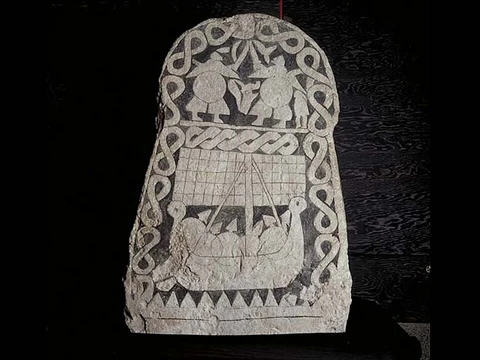
Harald Hardrada
King of Norway whose death marked the end of the Viking Age.

Unknown author · Public domain
Harald Sigurdsson (c. He is remembered for his unsuccessful claims to the Danish and English thrones, his years as a mercenary and commander in Kievan Rus' and the Byzantine Empire, and his death at the Battle of Stamford Bridge, which historians often consider the end of the Viking Age.
- known_for
- King of Norway; high-ranking officer in the Varangian Guard; invasion of England; death at Stamford Bridge
Lore & Background
Domestically, he crushed opposition, unified Norway, and instituted a coin economy and foreign trade. In 1066, invited by the exiled earl Tostig Godwinson, Harald invaded England with a large fleet—historical sources vary on exact numbers, but estimates often cite around 300 ships and thousands of troops. He won the Battle of Fulford on 20 September but was defeated and killed by Harold Godwinson's forces at Stamford Bridge on 25 September. While the Norse forces suffered devastating losses, some survivors escaped, including Harald's son Olaf.
Reader's Guide
Harald Hardrada's significance lies in his role as the last major Viking king to attempt the conquest of England, and his death at Stamford Bridge is widely seen as closing the Viking Age. His career illustrates the mobility and ambition of Norse leaders in the 11th century, moving from exile in Kievan Rus' to command of the Byzantine Varangian Guard, then to kingship in Norway. His epithets reflect contested legacies: 'Hardrada' (severe or resolute) appears in later Icelandic sagas, while earlier Insular sources call him 'Fairhair', possibly the name he preferred. His reign brought internal stability and economic reforms to Norway, but his foreign ambitions—especially the prolonged, unsuccessful war for Denmark and the fatal invasion of England—define his historical image. The battle that killed him also ended the threat of Norse conquest of England, paving the way for Norman consolidation under William the Conqueror. Modern scholarship questions the traditional genealogy linking him to Harald Fairhair, noting it likely reflects later political needs rather than historical fact.
Did You Know?
- Harald was called the 'Thunderbolt of the North' by chronicler Adam of Bremen.
- He served as a high-ranking officer in the Byzantine Varangian Guard, though evidence he was its commander is inconclusive.
- His epithet 'Hardrada' is a bastard Anglicisation of the Old Norse 'harðráði'.
- He was killed at the Battle of Stamford Bridge on 25 September 1066, after the English army under Harold Godwinson made a surprise approach that caught the Norse forces off guard.
The Mercenary Years in the East
Harald's fifteen years abroad shaped him as much as any single battle. After the 1030 defeat at Stiklestad, the young exile found himself in the service of Grand Prince Yaroslav the Wise in Kievan Rus', where he rose to the rank of captain. He climbed to the top of the Byzantine Varangian Guard, commanding elite troops in campaigns that stretched across the Mediterranean, Asia Minor, Sicily, possibly the Holy Land, Bulgaria, and the streets of Constantinople itself amid imperial succession disputes. He grew wealthy enough to ship his accumulated gold back to Yaroslav for safekeeping. When he finally left the Byzantine world in 1042, he returned to Rus' not as a penniless exile but as a battle-hardened commander with a fortune and a network of experienced warriors. This period transformed a teenage refugee into one of the most formidable military minds in northern Europe.
Seizing and Shaping the Norwegian Throne
Harald's path to the Norwegian crown was neither a single dramatic conquest nor a peaceful inheritance. Magnus, unwilling to fight his own uncle, struck a pragmatic deal: they would share the kingship, and Harald would share his considerable wealth in return. The arrangement lasted barely a year. His early reign was marked by a deliberate campaign to crush internal opposition and forge a more unified kingdom. Domestically, his rule brought a period of relative stability. He introduced a coin-based economy and actively promoted foreign trade, laying administrative groundwork that distinguished his Norway from the patchwork of chieftaincies that had preceded it. The "Thunderbolt of the North," as Adam of Bremen called him, had finally turned his formidable energy inward.
The Danish Wars and the English Gambit
With Norway secured, Harald set his sights on restoring the North Sea Empire that Cnut had once held. For nearly two decades he raided the Danish coast almost annually, clashing repeatedly with his former ally Sweyn II. The reprieve was brief. Tostig Godwinson, the exiled brother of England's Harold Godwinson, came to Harald offering the English crown. Harald accepted, assembling an enormous force of ten thousand men aboard three hundred longships. In September 1066 he struck northern England, routing the combined armies of Northumbria and Mercia at Fulford near York. Five days later, Harold Godwinson's forces fell upon him at Stamford Bridge in a devastating surprise attack. Harald was killed, his army annihilated. Historians frequently mark this moment as the closing chapter of the Viking Age.
The Name He Chose and the Name They Gave
The epithet by which Harald is best known—Harðráði, rendered in English as "Hardrada"—is far from settled. Translations range from "severe" and "resolute" to "tyrant" and "ruthless," and scholars like Judith Jesch and Alison Finlay disagree on the best rendering. More strikingly, a cluster of independent British-Irish sources, including the Anglo-Saxon Chronicle and the works of Orderic Vitalis, John of Worcester, and William of Malmesbury, call him a variant of "Fairhair" (hárfagri). For a long time, twentieth-century historians assumed these Insular writers had simply confused him with the earlier saga-king Harald Fairhair. But as scholars recognized the independence of those sources, a new picture emerged: "Fairhair" may well have been the name Harald himself preferred, while "severe" or "hard in counsel" was the label his opponents pinned on him. The saga tradition, written roughly two centuries later, cemented the harsher epithet and, in doing so, may have quietly erased the man's own self-presentation.
Common Misconceptions (Editorial)
Some believe Harald Hardrada was the commander of the Varangian Guard, but the facts indicate evidence for that role is inconclusive. Another common error is that his epithet "Hardrada" is a direct Old Norse term; in reality, it is a bastard Anglicisation of the Old Norse *harðráði*. Additionally, while his death at Stamford Bridge is well-known, his son Olaf survived the battle and escaped with some of the Norse forces.
Why It Matters (Editorial)
Harald Hardrada’s life epitomizes the restless ambition and far-reaching influence of the Viking Age, from the courts of Byzantium to the battlefields of England. His death at Stamford Bridge in 1066 marks a symbolic end to an era, reminding us that even the most formidable warriors and kings are ultimately subject to the turning tides of history.
Gallery
Frequently Asked Questions
What was Harald Hardrada known for?
He is best remembered for his ambitious claims to both the Danish and English thrones, his long career as a mercenary commander in Kievan Rus' and the Byzantine Empire, and his ultimate defeat at the Battle of Stamford Bridge. His service as a high-ranking officer in the Varangian Guard is also a notable part of his legacy.
How does Harald Hardrada's story end?
He was killed on 25 September 1066 during the Battle of Stamford Bridge, where he led a failed invasion of England against King Harold Godwinson. His death is widely regarded by historians as the closing event of the Viking Age.
Why is Harald Hardrada important in Viking history?
As the last Norse king to mount a serious military campaign against a Christian kingdom, his defeat at Stamford Bridge effectively ended the era of large-scale Viking raids and conquests. He represents the final generation of rulers who combined Scandinavian kingship with far-reaching military ambition.
What was Harald Hardrada's connection to the Byzantine Empire?
Before becoming king, he spent years serving as a senior commander in the Varangian Guard, the elite mercenary corps of the Byzantine emperor. This experience gave him extensive military training and exposure to Mediterranean warfare that he later brought back to Northern Europe.
More in The Viking Age 1-21
Spotted an error? Know more?
This is a living reference — every entry is fact-audited, and reader corrections feed straight into our audit queue. Suggest an edit · See this site's audit record