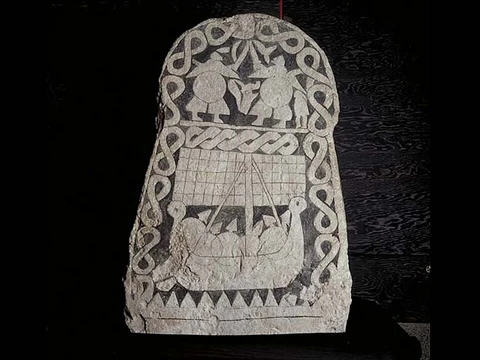
Scandinavian York
Viking-ruled kingdom in northern England, centered on York.

via Wikipedia: Viking Age · see source
The term is especially used for the city of York, which was controlled by a succession of Viking and Anglo-Saxon kings and earls, including the period when King Cnut ruled all of England as part of his North Sea Empire until his death in 1035. The Kingdom of Jórvík was closely associated with the longer-lived Kingdom of Dublin throughout this period.
- region
- Yorkshire (modern-day England)
- capital
- York (Jórvík)
- first_king
- Halfdan Ragnarsson (proclaimed 875/876)
- known_for
- Viking conquest and rule of York, intermittent Anglo-Saxon control, association with the Kingdom of Dublin
- notable_ruler
- Cnut (King of all England, part of North Sea Empire, died 1035)
Lore & Background
The Anglo-Saxon Chronicle called it the 'mycel heathen here' (Great Heathen Army). Led by Ivar the Boneless and his brother Halfdan Ragnarsson, the army moved north to Northumbria, which was in civil war. In 866/867 they captured York. After the Northumbrian leaders Osberht and Ælla were killed in battle on 21 March 867, the Vikings appointed a puppet ruler, Ecgberht. In 875/876, Halfdan Ragnarsson returned and was proclaimed King of Northumbria, though he ruled only southern Northumbria (Deira), which became the Kingdom of York (Jórvík).
Reader's Guide
Scandinavian York represents a key chapter in the Viking Age, illustrating the transition from raiding to settlement and political integration in England. The kingdom's history shows the ebb and flow of Viking and Anglo-Saxon control, with York serving as a major political and economic center. The close ties with the Kingdom of Dublin highlight the interconnectedness of Viking realms across the Irish Sea. The period also saw the first Christian Viking king of York, Guthred, and the eventual incorporation of the region into the unified English kingdom under Cnut and later the Norman Conquest. The Cuerdale Hoard, containing thousands of coins including Islamic dirhams, attests to York's role in extensive trade networks. The kingdom's legacy is preserved in archaeological finds and historical chronicles, offering insight into the complex interactions between Scandinavian settlers and the native Anglo-Saxon population.
Did You Know?
- The Cuerdale Hoard, discovered in the 19th century, contained approximately 8,000 Anglo-Scandinavian coins, including Islamic dirhams and coins with pseudo-Kufic markings.
Jórvík and the Architecture of Norse Power
The Norse expansion of the Viking Age produced a remarkable web of political entities stretching from the British Isles to the rivers of eastern Europe. Among these, the kingdom of Jórvík—what we now call York—stood as a testament to the ambition of Scandinavian settlers who carved out sovereign territories far from their homelands in Denmark, Norway, and Sweden. It is worth noting that the vast majority of these Scandinavians were not pirates in the narrow sense; the label 'Viking' was applied broadly to Norsemen engaged in raiding, trading, colonizing, and conquest alike. They established durable polities including the Danelaw, the Kingdom of the Isles, Orkney, Dublin, Normandy, and even Kievan Rus' along the Dnieper and Volga trade corridors. These colonies gave rise to entirely new peoples: the Normans, the Rus', the Faroese, the Icelanders, and the Norse-Gaels. At the height of this consolidation, a short-lived North Sea Empire briefly encompassed vast stretches of both Scandinavia and Britain, while the Norse homelands themselves were unified into larger kingdoms. The sea, rather than the land, served as the connective tissue binding this dispersed political world together, and Jórvík occupied a pivotal position within that maritime network.
Push, Pull, and the Sailing Revolution
The outward surge of Norse peoples from the eighth and ninth centuries was not the product of a single impulse but a convergence of pressures and possibilities. On the pull side, the growth of prosperous towns and monastic centers across the British Isles and continental Europe presented irresistible targets for communities whose own kingdoms—particularly the roughly thirty small Norwegian realms divided by mountains and fjords—offered limited arable land and chronic political fragmentation. Overpopulation and the political upheaval accompanying Norway's unification likely pushed restless populations seaward. The aggressive eastward push of the Carolingian Empire and its forced Christianization of the Saxons may have further compressed the space available to Norse communities. Equally important was a technological factor: innovations in shipbuilding and seamanship had, by the eighth century, made it feasible to sail farther and for longer durations than any previous generation. The sea, which had long served as the primary artery of communication between the Norwegian kingdoms and the outside world, became a highway for traders, colonists, explorers, and plunderers whose reach extended from the Baltic coast to the Dnieper and Volga rivers, and ultimately to the shores of Newfoundland.
Lindisfarne and the Shattering of Peace
The night of 8 June 793, when Viking warriors struck the abbey on Lindisfarne—a sacred island of learning off Northumberland's coast—shattered a long-held assumption of Christian inviolability in the British Isles. Monks were slain within the church, cast into the sea to drown, or hauled away as captives alongside the monastery's treasures. The Northumbrian scholar Alcuin of York, writing to convey the horror, declared that Britain had never before witnessed such a terror. The shock spawned the traditional, though unattested, liturgical plea for deliverance from the fury of the Northmen. This was not, however, the first Scandinavian contact with English shores. Three vessels had beached in Weymouth Bay four years earlier—an event the Anglo-Saxon Chronicle misdates to 787 due to a scribal error—and that earlier incursion may have been a trading expedition gone awry rather than a deliberate raid. The scholar Judith Jesch has argued the true opening of the Viking Age may extend back to 700–750, given archaeological evidence of earlier Scandinavian-British contact. What began as small-scale forays expanded through the ninth century, and by the time of Lindisfarne, the pattern of large-scale, coordinated assault had been firmly established.
From Wolves Among Sheep to Reassessed Achievements
For centuries, the narrative of the Viking Age in Britain was written entirely by those who suffered it. Chronicles such as Robert of Gloucester's thirteenth-century work painted the Norse raiders as 'wolves among sheep,' wholly violent and bloodthirsty. Even in Scandinavia, by the latter half of the eighteenth century, the period was still characterized as one of barbarism. The first challenges to this portrait emerged in the seventeenth century, when Danish scholars Thomas Bartholin and Ole Worm, along with the Swedish Olaus Rudbeck, began treating runic inscriptions and the Icelandic Sagas as legitimate primary historical evidence. During the Enlightenment and the Nordic Renaissance, figures like Thormodus Torfæus, Ludvig Holberg, and Olof von Dalin pushed toward a more rational reading of the sources. In Britain, the publication of Old Icelandic grammars and dictionaries in the Victorian era opened the Sagas to a wider scholarly audience, while linguists traced the Viking Age roots of countless rural idioms. It was not until the 1890s that scholars outside Scandinavia began to systematically recognize the Norse achievement in artistry, engineering, and maritime technology—transforming the Vikings from a caricature of savagery into a complex civilization whose settlements, including Jórvík, reshaped the political map of Europe.
Common Misconceptions (Editorial)
Some assume that Viking rule in York was continuous, but the facts show a succession of both Viking and Anglo-Saxon kings and earls controlled the city, with intermittent Anglo-Saxon control. Another common error is that the Kingdom of Jórvík was independent; in fact, it was closely associated with the Kingdom of Dublin and later became part of Cnut’s North Sea Empire, which ruled all of England.
Why It Matters (Editorial)
Scandinavian York represents a pivotal moment when Viking and Anglo-Saxon cultures collided and merged, shaping the political and economic landscape of northern England. Its legacy endures in the region’s identity, from place names to archaeological treasures like the Cuerdale Hoard, reminding us how early medieval power struggles and trade networks laid foundations for modern Britain.
Gallery

Frequently Asked Questions
What was the capital of Scandinavian York?
The city of York, known in Old Norse as Jórvík, served as the political and administrative heart of the kingdom. It changed hands multiple times between Viking and Anglo-Saxon rulers throughout the two-century span.
Why is Scandinavian York important in Viking history?
It represents one of the longest-lasting and most politically significant Norse footholds in mainland Europe, linking the Viking world of Dublin to the broader North Sea Empire. Its most famous ruler, Cnut, went on to unite all of England under his crown before his death in 1035.
More in The Viking Age 1-21
Spotted an error? Know more?
This is a living reference — every entry is fact-audited, and reader corrections feed straight into our audit queue. Suggest an edit · See this site's audit record