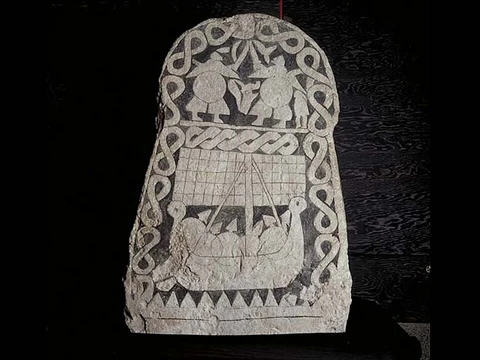
Runestones
Raised stones with runic inscriptions, mostly from the late Viking Age.

A runestone is typically a raised stone with a runic inscription, though the term can also apply to inscriptions on boulders and bedrock. The tradition of erecting runestones as memorials to dead men began in the 4th century and lasted into the 12th century, with most extant examples dating from the late Viking Age. While primarily found in Scandinavia, especially Sweden, runestones also appear in locations visited by Norsemen. They were usually brightly colored when erected, though the color has since worn off.
- Earliest appearance
- 4th–5th century
- Total known in Scandinavia
- about 3,000 runestones among about 6,000 runic inscriptions
- Highest concentration
- Uppland, Sweden (1,196 inscriptions)
- Outside Scandinavia
- Isle of Man (30 runestones), plus scattered finds in England, Ireland, Scotland, Faroe Islands, and Berezan'
- Primary purpose
- Mark territory, explain inheritance, boast about constructions, bring glory to dead kinsmen, tell of important events
Lore & Background
The tradition of raising stones with runic inscriptions first appeared in the 4th and 5th centuries in Norway and Sweden, where early runestones were usually placed next to graves, though their precise function as commemorative monuments has been questioned. The earliest Danish runestones appeared in the 8th and 9th centuries, and about 50 runestones survive from the Migration Period in Scandinavia. The tradition is mentioned in both Ynglinga saga and Hávamál, which note that for men of consequence a mound should be raised, and for other distinguished warriors a standing stone.
Reader's Guide
Runestones are significant as the most numerous surviving runic inscriptions from the Viking Age, providing direct evidence of language, naming practices, social structure, and religious change. The spread of runestones was likely accelerated by King Harald Bluetooth's baptism in Denmark in the 960s, after which he commanded a runestone that marked a new order and included Denmark's oldest depiction of Jesus. This inspired chieftains and powerful Norse clans to imitate him, leading to a runestone wave that spread northwards through Sweden. In most districts the fad died out after a generation, but in Uppland and Södermanland it lasted into the 12th century. The stones show the impact of Christianity: in Uppland, about 70% of the 1,196 stone inscriptions are explicitly Christian, with engraved crosses or Christian prayers. Scholars debate whether this reflects allegiance to a Christian king, a social fashion among certain clans, or inspiration from Danish Jelling stones or Irish high crosses. Runestones also reveal that most were raised in memory of men who died at home, contrary to common perception, and that only about one in eight was raised by a single woman.
Did You Know?
- King Harald Bluetooth's runestone from the 960s includes Denmark's oldest depiction of Jesus.
- Only about 40% of runestones were discovered in their original location; the rest have been found in churches, roads, bridges, graves, farms, and water routes.
- In Uppland, about 70% of the 1,196 stone inscriptions are explicitly Christian.
Common Misconceptions (Editorial)
Some people assume runestones were typically left in their natural stone color, but they were usually brightly colored when erected—the color has since worn off. Another common misconception is that runestones are exclusively a Viking Age phenomenon, but the tradition actually began in the 4th century and lasted into the 12th century, with early examples from the Migration Period. It is also often thought that runestones were only found in Scandinavia, but they also appear in locations visited by Norsemen, such as the Isle of Man, England, Ireland, Scotland, the Faroe Islands, and Berezan'.
Why It Matters (Editorial)
Runestones endure as a subject of lasting interest because they are one of the few direct, contemporary records left by the Norse peoples themselves, offering insights into their beliefs, social structures, and commemorative practices. Beyond their historical value, they also challenge modern assumptions about the Viking Age—revealing a society that was literate, often Christian, and deeply concerned with legacy and public memory.
Frequently Asked Questions
What exactly is a runestone?
A runestone is a raised stone bearing a runic inscription, though the term can also cover carvings made directly into boulders or bedrock. Most surviving examples date to the late Viking Age, and they were originally painted in bright colors that have since faded away.
Where are the most runestones concentrated?
The overwhelming majority of the roughly 3,000 known Scandinavian runestones sit in Sweden, with Uppland alone accounting for 1,196 inscriptions. That region is essentially the epicenter of the tradition.
Why did Norsemen erect runestones?
They served multiple social functions: marking territory, clarifying inheritance rights, boasting about building projects, and, most commonly, honoring a deceased kinsman with a public memorial. In short, they were the Viking Age's way of making a lasting public statement.
Are runestones found outside Scandinavia?
Yes—about 30 runestones have been identified on the Isle of Man, and scattered examples turn up in England, Ireland, Scotland, the Faroe Islands, and even Berezan'. Their presence there tracks the reach of Norse seafarers and settlers.
More in The Viking Age 1-21
Spotted an error? Know more?
This is a living reference — every entry is fact-audited, and reader corrections feed straight into our audit queue. Suggest an edit · See this site's audit record