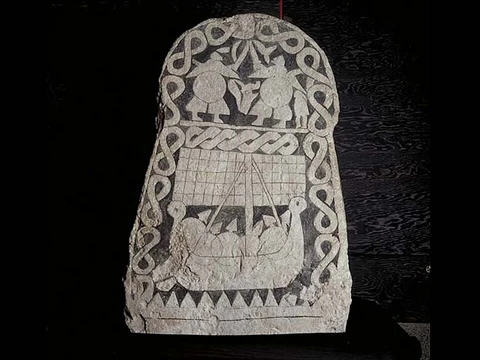
The Viking Age
Norsemen expanded across Europe and reached North America during the Viking Age.

The Viking Age (about 800–1050 CE) was the period during the Middle Ages when Norsemen known as Vikings undertook large-scale raiding, colonising, conquest, and trading throughout Europe and reached North America. The Viking Age applies not only to their homeland of Scandinavia but also to any place significantly settled by Scandinavians during the period. Although few of the Scandinavians of the Viking Age were Vikings in the sense of being engaged in piracy, they are often referred to as Vikings as well as Norsemen.
- Period
- about 800–1050 CE
- Region
- Scandinavia and areas settled by Scandinavians
- Known for
- Raiding, colonising, conquest, trading, reaching North America
- Languages
- Old Norse (precursor to present-day Scandinavian languages)
- Notable colonies
- British Isles, Ireland, Faroe Islands, Iceland, Greenland, Normandy, Baltic coast, Dnieper and Volga trade routes, Newfoundland
Lore & Background
The Viking Age began with the attack on Lindisfarne in 793, though some scholars argue for an earlier start around 700–750. The Norse people voyaged by sea from Denmark, Norway, and Sweden, settling in the British Isles, Ireland, the Faroe Islands, Iceland, Greenland, Normandy, and along the Baltic coast and the Dnieper and Volga trade routes in eastern Europe, where they were also known as Varangians. They briefly settled in Newfoundland, becoming the first Europeans to reach North America, a feat achieved in 1021.
Reader's Guide
The Viking Age represents a significant period of expansion and cultural exchange, driven by factors such as the growth of wealthy towns and monasteries overseas, weak kingdoms, overpopulation, lack of good farmland, political strife, and the aggressive expansion of the Carolingian Empire. Sailing innovations allowed the Vikings to travel farther and longer. Information about the Viking Age is drawn largely from primary sources written by those the Vikings encountered, as well as archaeology, supplemented with secondary sources such as the Icelandic Sagas. The Norse founded several kingdoms and earldoms, including the Kingdom of the Isles, Orkney, York, the Danelaw, Dublin, Normandy, and Kievan Rus'. The homelands were unified into larger kingdoms, and the short-lived North Sea Empire included large swathes of Scandinavia and Britain. Scholarly reassessment of Viking achievements, recognizing their artistry, technological skills, and seamanship, began outside Scandinavia in the 1890s.
Did You Know?
- The Viking attack on Lindisfarne in 793 is regarded as the beginning of the Viking Age, though some scholars push the start back to 700–750.
- In 1021, the Vikings reached North America, a date not determined until a millennium later.
- The Norse were also known as Varangians in eastern Europe along the Dnieper and Volga trade routes.
- The Vikings founded several kingdoms and earldoms, including the Danelaw, Dublin, Normandy, and Kievan Rus'.
Common Misconceptions (Editorial)
Some people think all Scandinavians during the Viking Age were Vikings, but the facts show that “few of the Scandinavians of the Viking Age were Vikings in the sense of being engaged in piracy.” Another common misconception is that the Viking Age began with a single, undisputed date; while the attack on Lindisfarne in 793 is regarded as the start, some scholars argue for an earlier beginning around 700–750.
Why It Matters (Editorial)
The Viking Age endures in historical imagination because it bridges the classical and medieval worlds while stretching across an extraordinary range of territories, from the Baltic to North America. It also highlights how a relatively small maritime culture could transform politics, trade, and settlement patterns across an entire continent, leaving lasting legacies in languages, place names, and legal systems.
Frequently Asked Questions
What was the Viking Age?
It was a roughly 250-year span (c. 800–1050 CE) during which Norse people from Scandinavia carried out widespread raiding, trading, and colonisation across Europe and as far as North America.
Were all Scandinavians actually Vikings?
No—only a small fraction of Norse people engaged in piracy or large-scale raiding. The broader population consisted of farmers, craftsmen, and traders, yet the entire Scandinavian society of that era is commonly labelled 'Vikings' or 'Norsemen' in historical writing.
Where did Norse settlers establish colonies?
Significant settlements sprang up in the British Isles, Ireland, Iceland, Greenland, the Faroe Islands, Normandy, and along the Baltic, Dnieper, and Volga trade routes, with the most distant confirmed outpost at Newfoundland.
What language did Vikings speak?
They spoke Old Norse, the direct ancestor of the modern Scandinavian languages such as Norwegian, Swedish, Danish, and Icelandic.
Why is the Viking Age considered significant?
It reshaped the political and cultural map of medieval Europe through conquest, long-distance trade networks, and settlement, and it produced one of the earliest known transatlantic contacts in recorded history.
More in The Viking Age 1-21
Spotted an error? Know more?
This is a living reference — every entry is fact-audited, and reader corrections feed straight into our audit queue. Suggest an edit · See this site's audit record